
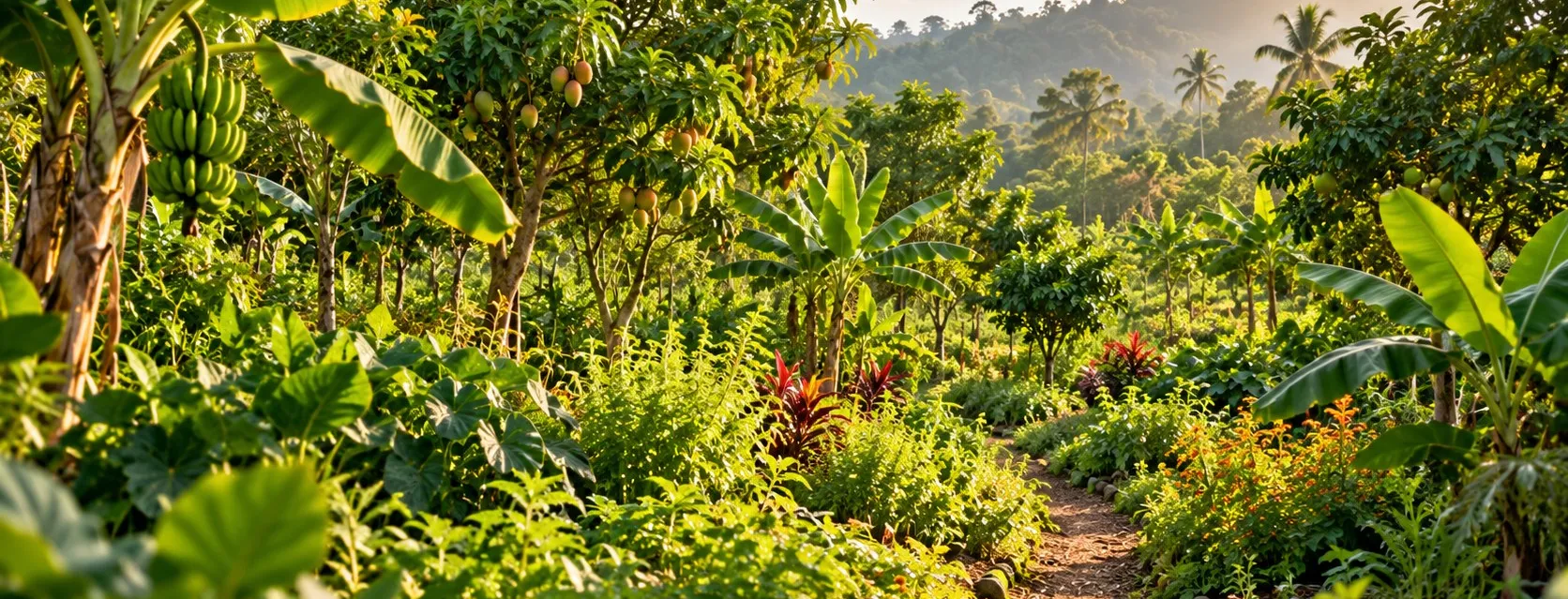
Complete ecosystem restoration on a 3 ha site in Uttar Pradesh, India
100% survival • Restored in 3 years
Farm profile
- Name
- Eco-retreat center
- Size (ha)
- 3 ha
- Location
- India, Uttar Pradesh, Govardhan
- Focus
- Landscape eco-regeneration
Situation
Originally the site was degraded land: depleted, eroded soil, low fertility and a weak food base for a natural ecosystem.
Plant survival rate was zero.
Objective
- Develop and implement a technological system to fully restore the natural ecosystem on the site.
- Ensure a 100% survival rate of planted plants in difficult climatic conditions.
- Create a resilient, self-sustaining ecosystem that provides the owners with diverse produce all year round.
- Optimize the plant protection system.
What we did
- A thorough analysis of the site’s initial condition was carried out (topography, soil, existing vegetation, water regime).
- A landscape design was developed for the site, taking into account the local climate and the center’s needs.
- A Premaculture project was implemented: a tree layer (fruit and shade trees such as mango, guava, jamun, etc.), shrub and herb layers, as well as landscaping and ponds.
- Advanced soil restoration methods were introduced (e.g. green manuring, composting, biotechnologies) that activate soil biota.
- An irrigation and care system was set up to ensure 100% seedling survival.
- Total number of plants planted — over 8,000
- Number of species — over 1,000
Results
-
Ecosystem restoration
- Before
- Degraded land with no signs of a stable ecosystem.
- After
- A self-sustaining ecosystem with a food chain (soil microorganisms, insects, birds, small mammals). In 8–10 years the system will be 90% self-sufficient and will no longer need heavy watering, intensive care or maintenance.
-
Plant survival rate
- Before
- Typical survival rate in the region is up to 82% (India average: 82% in the first year, 56% after 5 years).
- After
- 100% survival rate of all planted plants (excluding expected natural selection) — an outstanding result that exceeds average values.
-
Soil condition
- Before
- Depleted, eroded, structureless, lifeless
- After
- Healthy, well-structured soil with high organic matter content and active microflora.
-
Soil pH
- Before
- below 3
- After
- 5.5–6.5
-
Humus
- Before
- sand
- After
- chernozem
Yield. The system is designed to fully provide food, namely a wide range of fruits, berries, nuts, greens and vegetables (mango, guava, amla, papaya, pomegranate, fig, lychee, phalsa, bael, apples, plums, pears, jabuticaba, breadfruit, citrus, bananas, legumes, greens, vegetables, salads, spices) all year round.
An “eco-garden” of its own was created: produce is grown without “chemicals” and stands out for its excellent taste and consumer qualities.
Additional effect:
- Biodiversity: a balanced ecosystem with a rich variety of plant and animal species has formed.
- Higher soil water-holding capacity: improved soil structure retains moisture, erosion is reduced.
- Soil pH: was below 3, now 5.5–6.5
- Humus: sand is turning into chernozem
- Improved microclimate on the site.
Economics
ROI: not calculated, as the project was originally created for self-sufficiency and ecology.
Bhumi’s comprehensive approach restored the soil, created a self-sustaining garden system and turned a desert into a blossoming oasis in 3 years.
Video testimonial
Want the same results?


 More than 2,000 farmers already grow with Bhumi